
Podcast: Play in new window | Download (Duration: 28:00 — 25.6MB) | Embed Subscribe: Apple Podcasts | Spotify | Amazon Music | Android | Pandora | iHeartRadio | JioSaavn | Podchaser | Gaana | Podcast Index | Email | TuneIn | Deezer | Anghami | RSS | More

Episode 5 – Regnum Novum: Bringing forth the New Evangelization through Catholic Social Teaching with Omar Guiterrez – Value 4 Truth, Freedom, Justice, and Love part 2 “Justice”

From episode … 5. Truth, Freedom, Justice, and Love part 2 “Justice”
These are the four values of the Social Teaching of the Catholic Church as they’re enumerated in the Compendium and as they were laid out by, again, St. Pope John XXIII in Mater et magistra and Pacem in terris. Without these values, the work of social justice becomes an albatross around our necks. It pulls us down, threatening to poison all the work we do, no matter how well intentioned.
Justice requires we know what is due to our neighbor. But even when justice is achieved, it can be cold and impersonal, as Pope John Paul II said. This is why the phrase “social justice” appears so rarely in the Church’s Social Teaching. Justice is the bare minimum, and we are not looking for the minimum.
(Truth, Freedom and Love are covered in other episodes)
True social justice requires that we drop these paradigms of opposition: management vs. labor; bourgeois vs. proletariat; state vs. individual. We own the great Catholic both/and. It applies to the Social Teaching of the Catholic Church more than ever.
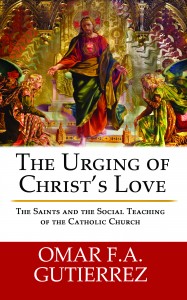 Omar F. A. Guiterrez, M.A. , Special Assistant to Archbishop George Lucas of the Archdiocese of Omaha. He’s also the author of “The Urging of Christ’s Love: The Saints and The Social Teaching of the Catholic”
Also visit Omar’s “Discerning Hearts” page Catholic Social Teaching 101

 Far from a clinical dissertation on Edith Stein’s writings, Anne introduces us to a woman with whom she has shared a rich spiritual friendship. By learning from and then implementing her wealth of teaching, Anne gives a saint who can help us to grow in faith and wisdom . Highly recommended!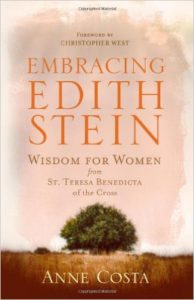



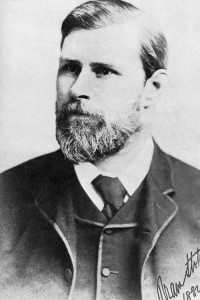

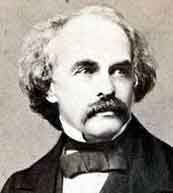 A key figure in the development of American literature, Nathaniel Hawthorne was also profoundly influenced by his ancestors and the Christianity that underscored their Puritan heritage. A literary classic, The Scarlet Letter presents a profound meditation on the nature of sin, repentance, and redemption, and how such Christian concepts may be integrated into American democracy.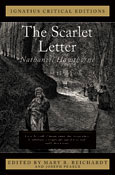





 unseen hand of providence felt by the reader. In his mythical creations or sub-creations, as he would call them, he shows how the unseen hand of God is felt far more forcefully in myth than it is ever felt in fiction. Paradoxically, fiction works with facts, albeit invented facts, whereas myth works with truth, albeit truth dressed in fancy disguises. Furthermore, since facts are physical and truth is metaphysical, myth, being metaphysical, is spiritual.”
 Joseph Pearce is currently the Writer-in-Residence and Visiting Fellow at Thomas More College of Liberal Arts in Merrimack, New Hampshire. He is also Visiting Scholar at Mount Royal Academy in Sunapee, New Hampshire. He is also Visiting Scholar at Mount Royal Academy in Sunapee, New Hampshire. He is co-editor of the Saint Austin Review (or StAR), an international review of Christian culture, literature, and ideas published in England (Family Publications) and the United States (Sapientia Press). He is also the author of many books, including literary biographies of Solzhenitsyn, J. R. R. Tolkien, C. S. Lewis, G. K. Chesterton, and Oscar Wilde.
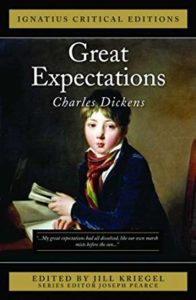 Based on the Ignatius Critical Edition, this series examines, from the Judeo-Christian perspective, the life, the times, and influence of authors of great works in literature.