What Mass was like at St. Peter’s in the 1600s—and why it was so strangely beautiful. Fr. Fessio breaks down chapter 3, section 2, of his teacher Joseph Ratzinger’s masterpiece “The Spirit of the Liturgy.”
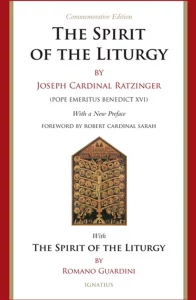
In honor of its fortieth anniversary (1978–2018), Ignatius Press presents a special Commemorative Edition of one of the most important works written by Joseph Ratzinger, The Spirit of the Liturgy.
This edition includes the earlier classic work with the same title by Servant of God Romano Guardini, a book that helped Ratzinger to “rediscover the liturgy in all its beauty, hidden wealth and time-transcending grandeur, to see it as the animating center of the Church, the very center of Christian life.”
Considered by Ratzinger devotees as one of his greatest works, this profound and beautifully written treatment of the liturgy will help readers to deepen their understanding of the”great prayer of the Church”. The cardinal discusses fundamental misunderstandings of the Second Vatican Council’s intentions for liturgical renewal, especially about the priest’s orientation of prayer to the Father, the placement of the tabernacle in churches, and the posture of kneeling.
Other important topics are the essence of worship, the Jewish roots of Christian prayer, the relationship of the liturgy to time and space, sacred art and music, and the active participation of the faithful in the Mass.
What a joy to discuss the 2nd edition of “The Spiritual Direction of St. Claude de la Colombiere” with John Galten, who wrote the forward to the book. Filled with an abundance of wisdom this little work is a must for those seeking solid spiritual guidance. In this podcast, we discuss the great legacy of St. Claude as well as the historical and spiritual richness of the devotion to the Sacred Heart of Jesus. John is a delight to talk with him, his joy for Christ and deep respect for St. Claude is utterly engaging.
This book contains a great treasure of spiritual insight and guidance for the soul who is seeking God. –Fr. Kenneth Baker, S.J., Author, Inside the Bible
Saint Claude has been one of my most important spiritual guides for a half century. This little jewel is a must for those who seek God’s will and mercy expressed in the most authentic devotion to Christ. –Fr. Benedict Groeschel, C.F.R., Author, Arise from Darkness
I Have No Fervor & I Feel Sad – Struggles in the Spiritual Life with Fr. Timothy Gallagher O.M.V.
Fr. Timothy Gallagher and Kris McGregor continue a 20-part series on the various Struggles in the Spiritual Life. This episode explores spiritual discouragement and lack of enthusiasm as well as sadness as forms of desolation.
How should we understand Beth’s experience this Wednesday evening? We have no indication that Beth is at fault. She is faithful. She prepares and attends the class in her usual way. She does her best to participate — so well in fact, that none perceive her lack of enthusiasm. What, then, is Beth experiencing?
Having followed Ignatius thus far, we can guess the answer! This Wednesday evening, Beth experiences a form of spiritual desolation. She feels, to use Ignatius’s words, “totally tepid,” that is, completely without fervor as she performs a spiritual practice. In this form of desolation, we feel spiritually lukewarm, indifferent, unenthusiastic, without affect. When we pray, serve the Lord, live our vocations, take new steps in our spiritual lives, seek holiness, but find ourselves tepid and without fervor as we do these things, we are experiencing spiritual desolation. The adverb “totally” is again expressive.
Have you ever felt this form of spiritual desolation? Yes, certainly, we all have at times. Obviously, the enemy’s goal is that such tepidity cause us to question ourselves, to lose heart, to abandon these helpful practices. Beth responds well when she remains faithful, the right response for us as well.
Once again, no shame! No surprise! Be aware, identify, reject.
Gallagher O.M.V, Fr. Timothy ; Gallagher O.M.V, Fr. Timothy. Struggles in the Spiritual Life: Their Nature and Their Remedies (pp. 76-77). Sophia Institute Press. Kindle Edition.
An excerpt from the chapter, “I Feel Sad”:
Before Paul — or we — can answer these questions, we need to identify the sadness he feels. Paul is faithful to prayer and has been for years. He loves it, and he feels its fruits. Though the sadness weighs on him, Paul does not let it stop him. In fact, he is progressing in prayer, as his increased awareness of his experience reveals. Paul now notes spiritual movements, even this undramatic, nonclamorous sense of sadness. He can identify the thoughts from which it originates. Paul’s sadness, then, does not derive from negligence on his part.
How, then, should we understand it? Paul experiences a form of spiritual desolation that Ignatius describes as finding oneself “totally sad.” Paul is not yet “totally” sad, but things appear to be moving in that direction.
Once again, no shame, so surprise; be aware, identify, reject. This sadness is distinct from the healthy — even if painful — sadness we feel at the loss of a loved one, the termination of a rewarding occupation, and the like.
This is a spiritual sadness with nothing healthy about it. It arises from lies of the enemy. He tells you that you should be ashamed to bring such “small” things to prayer — to the God who knows when a sparrow falls to the ground and counts the hairs on your head (Luke 12:6–7), the God to whom everything in your life is important. The enemy tells you that you are not really praying — when, in reality, God is calling you to a simpler and richer prayer. The enemy tells you that you have stopped at the threshold of deep prayer — when you have only encountered the dry and distracted moments that all who pray faithfully experience. All this is from the liar and father of lies! The only fitting response is to unmask the lies and reject them.
Gallagher O.M.V, Fr. Timothy ; Gallagher O.M.V, Fr. Timothy. Struggles in the Spiritual Life: Their Nature and Their Remedies (pp. 81-82). Sophia Institute Press. Kindle Edition.
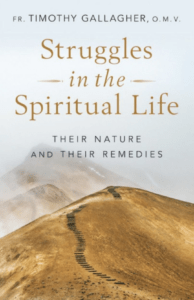
From the book’s description: “Here is a powerful, life-changing book that will help you understand and conquer the struggles you face in your spiritual life. It’s a book for those who love the Lord and desire holiness yet often feel adrift or stagnant in their search for spiritual growth.
All of us encounter valleys on our journey with the Lord — those periods of spiritual desolation that are a painful yet unavoidable feature of our prayer life. Spiritual desolation is as complex as we are, so understanding what is happening and responding to it properly are critical to reaching the heights of holiness.
With warmth and understanding, Fr. Gallagher carefully identifies in this book the various forms of spiritual and nonspiritual desolation and supplies the remedy for each. You’ll learn how to discern whether your struggles derive from medical or psychological conditions or whether those struggles are spiritual and permitted by the Lord for reasons of growth. In each case, you’ll be given the remedy for the struggle. You’ll also learn the forms of spiritual dryness and of the Dark Night — and how to respond to them.
In chapter after chapter, Fr. Gallagher presents a particular struggle as experienced by fictional characters and then provides the advice he gives to those who come to him for spiritual direction about that struggle. You’ll gain confidence as you journey through desolation, and you’ll learn to reject the enemy’s ploys to infect you with a sense of hopelessness.”
Did you know that Fr. Timothy Gallagher has 14 different podcast series on Discerning Hearts Catholic Podcasts?
Visit here to discover more!
Sunday of the Sixth Week in Ordinary Time – A Time of Lectio Divina for the Discerning Heart Podcast
As you begin, take a deep breath and exhale slowly. For at least the next few moments, surrender all the cares and concerns of this day to the Lord.
Say slowly from your heart “Jesus, I Trust In You…You Take Over”
Become aware that He is with you, looking upon you with love, wanting to be heard deep within in your heart…
From the Holy Gospel of St. Matthew 5:17-37
Jesus said to his disciples: ‘Do not imagine that I have come to abolish the Law or the Prophets. I have come not to abolish but to complete them. I tell you solemnly, till heaven and earth disappear, not one dot, not one little stroke, shall disappear from the Law until its purpose is achieved. Therefore, the man who infringes even one of the least of these commandments and teaches others to do the same will be considered the least in the kingdom of heaven; but the man who keeps them and teaches them will be considered great in the kingdom of heaven.
‘For I tell you, if your virtue goes no deeper than that of the scribes and Pharisees, you will never get into the kingdom of heaven.
‘You have learnt how it was said to our ancestors: You must not kill; and if anyone does kill he must answer for it before the court. But I say this to you: anyone who is angry with his brother will answer for it before the court; if a man calls his brother “Fool” he will answer for it before the Sanhedrin; and if a man calls him “Renegade” he will answer for it in hell fire. So then, if you are bringing your offering to the altar and there remember that your brother has something against you, leave your offering there before the altar, go and be reconciled with your brother first, and then come back and present your offering. Come to terms with your opponent in good time while you are still on the way to the court with him, or he may hand you over to the judge and the judge to the officer, and you will be thrown into prison. I tell you solemnly, you will not get out till you have paid the last penny.
‘You have learnt how it was said: You must not commit adultery. But I say this to you: if a man looks at a woman lustfully, he has already committed adultery with her in his heart. If your right eye should cause you to sin, tear it out and throw it away; for it will do you less harm to lose one part of you than to have your whole body thrown into hell. And if your right hand should cause you to sin, cut it off and throw it away; for it will do you less harm to lose one part of you than to have your whole body go to hell.
‘It has also been said: Anyone who divorces his wife must give her a writ of dismissal. But I say this to you: everyone who divorces his wife, except for the case of fornication, makes her an adulteress; and anyone who marries a divorced woman commits adultery.
‘Again, you have learnt how it was said to our ancestors: You must not break your oath, but must fulfil your oaths to the Lord. But I say this to you: do not swear at all, either by heaven, since that is God’s throne; or by the earth, since that is his footstool; or by Jerusalem, since that is the city of the great king. Do not swear by your own head either, since you cannot turn a single hair white or black. All you need say is “Yes” if you mean yes, “No” if you mean no; anything more than this comes from the evil one.’
What word made this passage come alive for you?
What did you sense the Lord saying to you?
Once more give the Lord an opportunity to speak to you:
Jesus said to his disciples: ‘Do not imagine that I have come to abolish the Law or the Prophets. I have come not to abolish but to complete them. I tell you solemnly, till heaven and earth disappear, not one dot, not one little stroke, shall disappear from the Law until its purpose is achieved. Therefore, the man who infringes even one of the least of these commandments and teaches others to do the same will be considered the least in the kingdom of heaven; but the man who keeps them and teaches them will be considered great in the kingdom of heaven.
‘For I tell you, if your virtue goes no deeper than that of the scribes and Pharisees, you will never get into the kingdom of heaven.
‘You have learnt how it was said to our ancestors: You must not kill; and if anyone does kill he must answer for it before the court. But I say this to you: anyone who is angry with his brother will answer for it before the court; if a man calls his brother “Fool” he will answer for it before the Sanhedrin; and if a man calls him “Renegade” he will answer for it in hell fire. So then, if you are bringing your offering to the altar and there remember that your brother has something against you, leave your offering there before the altar, go and be reconciled with your brother first, and then come back and present your offering. Come to terms with your opponent in good time while you are still on the way to the court with him, or he may hand you over to the judge and the judge to the officer, and you will be thrown into prison. I tell you solemnly, you will not get out till you have paid the last penny.
‘You have learnt how it was said: You must not commit adultery. But I say this to you: if a man looks at a woman lustfully, he has already committed adultery with her in his heart. If your right eye should cause you to sin, tear it out and throw it away; for it will do you less harm to lose one part of you than to have your whole body thrown into hell. And if your right hand should cause you to sin, cut it off and throw it away; for it will do you less harm to lose one part of you than to have your whole body go to hell.
‘It has also been said: Anyone who divorces his wife must give her a writ of dismissal. But I say this to you: everyone who divorces his wife, except for the case of fornication, makes her an adulteress; and anyone who marries a divorced woman commits adultery.
‘Again, you have learnt how it was said to our ancestors: You must not break your oath, but must fulfil your oaths to the Lord. But I say this to you: do not swear at all, either by heaven, since that is God’s throne; or by the earth, since that is his footstool; or by Jerusalem, since that is the city of the great king. Do not swear by your own head either, since you cannot turn a single hair white or black. All you need say is “Yes” if you mean yes, “No” if you mean no; anything more than this comes from the evil one.’
What did your heart feel as you listened?
What did you sense the Lord saying to you?
Once more, through Him, with Him and in Him listen to the Word:
Jesus said to his disciples: ‘Do not imagine that I have come to abolish the Law or the Prophets. I have come not to abolish but to complete them. I tell you solemnly, till heaven and earth disappear, not one dot, not one little stroke, shall disappear from the Law until its purpose is achieved. Therefore, the man who infringes even one of the least of these commandments and teaches others to do the same will be considered the least in the kingdom of heaven; but the man who keeps them and teaches them will be considered great in the kingdom of heaven.
‘For I tell you, if your virtue goes no deeper than that of the scribes and Pharisees, you will never get into the kingdom of heaven.
‘You have learnt how it was said to our ancestors: You must not kill; and if anyone does kill he must answer for it before the court. But I say this to you: anyone who is angry with his brother will answer for it before the court; if a man calls his brother “Fool” he will answer for it before the Sanhedrin; and if a man calls him “Renegade” he will answer for it in hell fire. So then, if you are bringing your offering to the altar and there remember that your brother has something against you, leave your offering there before the altar, go and be reconciled with your brother first, and then come back and present your offering. Come to terms with your opponent in good time while you are still on the way to the court with him, or he may hand you over to the judge and the judge to the officer, and you will be thrown into prison. I tell you solemnly, you will not get out till you have paid the last penny.
‘You have learnt how it was said: You must not commit adultery. But I say this to you: if a man looks at a woman lustfully, he has already committed adultery with her in his heart. If your right eye should cause you to sin, tear it out and throw it away; for it will do you less harm to lose one part of you than to have your whole body thrown into hell. And if your right hand should cause you to sin, cut it off and throw it away; for it will do you less harm to lose one part of you than to have your whole body go to hell.
‘It has also been said: Anyone who divorces his wife must give her a writ of dismissal. But I say this to you: everyone who divorces his wife, except for the case of fornication, makes her an adulteress; and anyone who marries a divorced woman commits adultery.
‘Again, you have learnt how it was said to our ancestors: You must not break your oath, but must fulfil your oaths to the Lord. But I say this to you: do not swear at all, either by heaven, since that is God’s throne; or by the earth, since that is his footstool; or by Jerusalem, since that is the city of the great king. Do not swear by your own head either, since you cannot turn a single hair white or black. All you need say is “Yes” if you mean yes, “No” if you mean no; anything more than this comes from the evil one.’
What touched your heart in this time of prayer?
What did your heart feel as you prayed?
What do you hope to carry with you from this time with the Lord?
Our Father, who art in heaven,
hallowed be thy name.
Thy kingdom come.
Thy will be done on earth, as it is in heaven.
Give us this day our daily bread,
and forgive us our trespasses,
as we forgive those who trespass against us,
and lead us not into temptation,
but deliver us from evil.
Amen
Excerpt from THE JERUSALEM BIBLE, copyright (c) 1966 by Darton, Longman & Todd, Ltd. and Doubleday, a division of Penguin Random House, Inc. Reprinted by Permission.
In honor of its fortieth anniversary (1978–2018), Ignatius Press presents a special Commemorative Edition of one of the most important works written by Joseph Ratzinger, The Spirit of the Liturgy.
This edition includes the earlier classic work with the same title by Servant of God Romano Guardini, a book that helped Ratzinger to “rediscover the liturgy in all its beauty, hidden wealth and time-transcending grandeur, to see it as the animating center of the Church, the very center of Christian life.”
Considered by Ratzinger devotees as one of his greatest works, this profound and beautifully written treatment of the liturgy will help readers to deepen their understanding of the”great prayer of the Church”. The cardinal discusses fundamental misunderstandings of the Second Vatican Council’s intentions for liturgical renewal, especially about the priest’s orientation of prayer to the Father, the placement of the tabernacle in churches, and the posture of kneeling.
Other important topics are the essence of worship, the Jewish roots of Christian prayer, the relationship of the liturgy to time and space, sacred art and music, and the active participation of the faithful in the Mass.
I Don’t Have the Energy – Struggles in the Spiritual Life with Fr. Timothy Gallagher O.M.V.
Fr. Timothy Gallagher and Kris McGregor continue a 20-part series on the various Struggles in the Spiritual Life. This episode explores spiritual discouragement and a form of spiritual desolation that takes on the form of tiredness and exhaustion.
An excerpt from the chapter, “I Don’t Have the Energy”:
In this form of desolation, we feel spiritually sluggish, indolent, lazy, lackadaisical. The adverb “totally” is powerful: in time of spiritual desolation, we may feel totally sluggish, lazy, and slothful as regards various aspects of our spiritual lives. We feel no energy for prayer, for God’s service, for involvement in our parish, for holiness in our vocations, and the like. The feeling of slothfulness in spiritual desolation may contrast sharply with the energy we more habitually feel for these same things when not in desolation.
There is no shame in experiencing this form of spiritual desolation. We all do at times. What is important — Julie is on target with this — is to be aware of it, understand it for the tactic of the enemy that it is, and firmly reject it. For Bob, this means that he should not renounce leadership of the group until he has greater clarity about his spiritual situation (rule 5: in time of desolation, never make a change). That change will not resolve his lack of energy; identifying and rejecting the desolation will. Bob may further apply the means Ignatius offers to resist and overcome the desolation: prayer of petition, meditation, examination, suitable penance, and the rest.
Gallagher O.M.V, Fr. Timothy ; Gallagher O.M.V, Fr. Timothy. Struggles in the Spiritual Life: Their Nature and Their Remedies (pp. 72-73). Sophia Institute Press. Kindle Edition.
From the book’s description: “Here is a powerful, life-changing book that will help you understand and conquer the struggles you face in your spiritual life. It’s a book for those who love the Lord and desire holiness yet often feel adrift or stagnant in their search for spiritual growth.
All of us encounter valleys on our journey with the Lord — those periods of spiritual desolation that are a painful yet unavoidable feature of our prayer life. Spiritual desolation is as complex as we are, so understanding what is happening and responding to it properly are critical to reaching the heights of holiness.
With warmth and understanding, Fr. Gallagher carefully identifies in this book the various forms of spiritual and nonspiritual desolation and supplies the remedy for each. You’ll learn how to discern whether your struggles derive from medical or psychological conditions or whether those struggles are spiritual and permitted by the Lord for reasons of growth. In each case, you’ll be given the remedy for the struggle. You’ll also learn the forms of spiritual dryness and of the Dark Night — and how to respond to them.
In chapter after chapter, Fr. Gallagher presents a particular struggle as experienced by fictional characters and then provides the advice he gives to those who come to him for spiritual direction about that struggle. You’ll gain confidence as you journey through desolation, and you’ll learn to reject the enemy’s ploys to infect you with a sense of hopelessness.”
Did you know that Fr. Timothy Gallagher has 14 different podcast series on Discerning Hearts Catholic Podcasts?
Visit here to discover more!
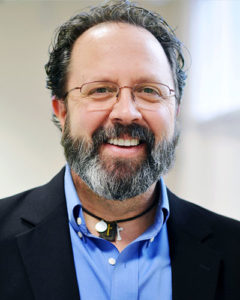
Episode 10 – The Battles of the Sixth Mansion – St. Teresa, Spiritual Warfare, and the Progress of the Soul with Dan Burke
Join Dan Burke and Kris McGregor as they discuss the teachings of the great spiritual master and Doctor of the Church, St. Teresa of Avila. The focus of their conversations will primarily reside in St. Teresa’s “Interior Castle” and her wisdom in regard to the activity of the enemy and the reality of spiritual warfare.
“Have you ever considered that the devil is active in your prayer life? In the parish church where you attend Mass? In the lives and actions of people of goodwill all around you? The saints remind us of a key aspect of living the spiritual life that we are wont to forget simply because we can’t see it and because we have been conditioned by the media and popular culture to think the devil works visibly only in “bad” people or in extraordinary ways, as in the movies. And although demons are certainly capable of extravagant or extraordinary manifestations, their ordinary work flies under our radar because it just isn’t that spectacular, though it is deadly.
In fact, subtlety, illusion, and deceit are their preferred methods of attack. An invisible battle for souls is being waged in and around us without reprieve, and we remain ignorant of it to our peril. St. Teresa of Avila, great mystic and Doctor of the Church, is best known for her writings on the way God leads souls along the path to union with Him through prayer. What many do not know about St. Teresa is that she also observed the actions of demons working with militant force to lead even good souls astray in ways that might surprise you. She shares these experiences freely in her autobiography, which she was commanded to write under obedience to her spiritual director.“
Burke, Dan; Burke, Dan. The Devil in the Castle: St. Teresa of Avila, Spiritual Warfare, and the Progress of the Soul (p. 12). Sophia Institute Press. Kindle Edition.
Dan Burke is the founder and President of the Avila Institute for Spiritual Formation, which offers graduate and personal enrichment studies in spiritual theology to priests, deacons, religious, and laity in 72 countries and prepares men for seminary in 14 dioceses.
Dan is the author and editor of more than 15 books on authentic Catholic spirituality and hosts the Divine Intimacy Radio show with his wife, Stephanie, which is broadcast weekly on EWTN Radio. Past episodes can be found, along with thousands of articles on the interior life, at SpiritualDirection.com.
In his deep commitment to the advancement of faithful Catholic spirituality, he is also the founder of Apostoli Viae, a world-wide, private association of the faithful dedicated to living and advancing the authentic spiritual patrimony of the Church.
Most importantly, Dan is a blessed husband, father of four, grandfather of one—and grateful to be Catholic.
Sunday of the Fifth Week in Ordinary Time – A Time of Lectio Divina for the Discerning Heart Podcast
As you begin, take a deep breath and exhale slowly. For at least the next few moments, surrender all the cares and concerns of this day to the Lord.
Say slowly from your heart “Jesus, I Trust In You…You Take Over”
Become aware that He is with you, looking upon you with love, wanting to be heard deep within in your heart…
From the Holy Gospel of St. Matthew 5:13-16
Jesus said to his disciples: ‘You are the salt of the earth. But if salt becomes tasteless, what can make it salty again? It is good for nothing, and can only be thrown out to be trampled underfoot by men.
‘You are the light of the world. A city built on a hill-top cannot be hidden. No one lights a lamp to put it under a tub; they put it on the lamp-stand where it shines for everyone in the house. In the same way your light must shine in the sight of men, so that, seeing your good works, they may give the praise to your Father in heaven.’
What word made this passage come alive for you?
What did you sense the Lord saying to you?
Once more give the Lord an opportunity to speak to you:
Jesus said to his disciples: ‘You are the salt of the earth. But if salt becomes tasteless, what can make it salty again? It is good for nothing, and can only be thrown out to be trampled underfoot by men.
‘You are the light of the world. A city built on a hill-top cannot be hidden. No one lights a lamp to put it under a tub; they put it on the lamp-stand where it shines for everyone in the house. In the same way your light must shine in the sight of men, so that, seeing your good works, they may give the praise to your Father in heaven.’
What did your heart feel as you listened?
What did you sense the Lord saying to you?
Once more, through Him, with Him and in Him listen to the Word:
Jesus said to his disciples: ‘You are the salt of the earth. But if salt becomes tasteless, what can make it salty again? It is good for nothing, and can only be thrown out to be trampled underfoot by men.
‘You are the light of the world. A city built on a hill-top cannot be hidden. No one lights a lamp to put it under a tub; they put it on the lamp-stand where it shines for everyone in the house. In the same way your light must shine in the sight of men, so that, seeing your good works, they may give the praise to your Father in heaven.’
What touched your heart in this time of prayer?
What did your heart feel as you prayed?
What do you hope to carry with you from this time with the Lord?
Our Father, who art in heaven,
hallowed be thy name.
Thy kingdom come.
Thy will be done on earth, as it is in heaven.
Give us this day our daily bread,
and forgive us our trespasses,
as we forgive those who trespass against us,
and lead us not into temptation,
but deliver us from evil.
May the Lord bless us, and keep us from all evil, and bring us to everlasting life.
Amen
Excerpt from THE JERUSALEM BIBLE, copyright (c) 1966 by Darton, Longman & Todd, Ltd. and Doubleday, a division of Penguin Random House, Inc. Reprinted by Permission.
Life between heaven and earth: how the liturgy touches eternity. Father Fessio continues to walk us through “The Spirit of the Liturgy” by his teacher, Joseph Ratzinger (Pope Benedict XVI).
In honor of its fortieth anniversary (1978–2018), Ignatius Press presents a special Commemorative Edition of one of the most important works written by Joseph Ratzinger, The Spirit of the Liturgy.
This edition includes the earlier classic work with the same title by Servant of God Romano Guardini, a book that helped Ratzinger to “rediscover the liturgy in all its beauty, hidden wealth and time-transcending grandeur, to see it as the animating center of the Church, the very center of Christian life.”
Considered by Ratzinger devotees as one of his greatest works, this profound and beautifully written treatment of the liturgy will help readers to deepen their understanding of the”great prayer of the Church”. The cardinal discusses fundamental misunderstandings of the Second Vatican Council’s intentions for liturgical renewal, especially about the priest’s orientation of prayer to the Father, the placement of the tabernacle in churches, and the posture of kneeling.
Other important topics are the essence of worship, the Jewish roots of Christian prayer, the relationship of the liturgy to time and space, sacred art and music, and the active participation of the faithful in the Mass.
The Presentation in the Temple – Building a Kingdom of Love with Msgr. John Esseff
Msgr. John Esseff and Kris McGregor discuss the Feast of the Presentation, celebrated on February 2nd. They delve into the biblical account of Joseph and Mary presenting the infant Jesus in the temple, fulfilling the Jewish law.
The focus is on the profound encounter with Simeon and Anna, who recognize Jesus as the Messiah. Msgr. Esseff emphasizes the immediate and personal encounter with Jesus within oneself, stressing the importance of recognizing Him in daily life, family, and community.
Discerning Hearts reflection questions for this episode:
Feast of the Presentation Significance: What significance does the Feast of the Presentation hold, and how does it commemorate the biblical account of Joseph and Mary presenting Jesus in the temple?
Fulfillment of Jewish Law: How did Joseph and Mary, devout Jews, fulfill the requirements of the Jewish law by presenting Jesus in the temple 40 days after His birth?
Encounter with Simeon: Reflect on Simeon’s encounter with the infant Jesus. How does Simeon’s recognition of Jesus as the Messiah reflect the fulfillment of divine promises?
Prophecy and Blessing: Explore the powerful prophecy spoken by Simeon and the blessing bestowed upon Mary and Joseph. How do these prophetic words foreshadow the challenges and significance of Jesus’ life?
Prophetess Anna: Consider the role of Prophetess Anna in the presentation scene. How does her devout life and recognition of Jesus contribute to the unfolding narrative?
Interior Encounter with Jesus: Reflect on Msgr. Esseff’s emphasis on the immediate encounter with Jesus within oneself. How can one cultivate this interior relationship with Jesus in daily life?
Recognizing Jesus in Others: In what ways does Msgr. Esseff encourage recognizing Jesus in family members and others in the community? How does this recognition contribute to building relationships?
The Temple Within: How does Msgr. Esseff underscore the concept of being the temple of God and encountering Jesus within? What practices, like morning prayer, does he suggest for fostering this awareness?
Family as a Sacred Unit: Reflect on Msgr. Esseff’s insights into seeing family members as reflections of Christ. How can recognizing Christ within family members strengthen familial bonds?
Mission Beyond the Church: Consider Msgr. Esseff’s perspective on the mission after leaving the church, bringing Jesus into the world. How does this concept align with the universal availability of Jesus in daily life?
Prayer for Trust: Explore the efficacious novena to the Sacred Heart of Jesus. How does this prayer, rooted in trust, align with the themes discussed in the podcast?
Applying Psalm Responsorial: Apply the words of the responsorial psalm from the Mass to personal reflection. How can one open the portals of their heart to let the King of Glory, Jesus, enter?
When the days were completed for their purification
according to the law of Moses,
Mary and Joseph took Jesus up to Jerusalem
to present him to the Lord,
just as it is written in the law of the Lord, Every male that opens the womb shall be consecrated to the Lord,
and to offer the sacrifice of a pair of turtledoves or two young pigeons,
in accordance with the dictate in the law of the Lord.
Now there was a man in Jerusalem whose name was Simeon.
This man was righteous and devout,
awaiting the consolation of Israel,
and the Holy Spirit was upon him.
It had been revealed to him by the Holy Spirit
that he should not see death
before he had seen the Christ of the Lord.
He came in the Spirit into the temple;
and when the parents brought in the child Jesus
to perform the custom of the law in regard to him,
he took him into his arms and blessed God, saying:
“Now, Master, you may let your servant go
in peace, according to your word,
for my eyes have seen your salvation,
which you prepared in the sight of all the peoples:
a light for revelation to the Gentiles,
and glory for your people Israel.”
The child’s father and mother were amazed at what was said about him;
and Simeon blessed them and said to Mary his mother,
“Behold, this child is destined
for the fall and rise of many in Israel,
and to be a sign that will be contradicted
—and you yourself a sword will pierce—
so that the thoughts of many hearts may be revealed.”
There was also a prophetess, Anna,
the daughter of Phanuel, of the tribe of Asher.
She was advanced in years,
having lived seven years with her husband after her marriage,
and then as a widow until she was eighty-four.
She never left the temple,
but worshiped night and day with fasting and prayer.
And coming forward at that very time,
she gave thanks to God and spoke about the child
to all who were awaiting the redemption of Jerusalem.
When they had fulfilled all the prescriptions
of the law of the Lord,
they returned to Galilee, to their own town of Nazareth.
The child grew and became strong, filled with wisdom;
and the favor of God was upon him.
Msgr. John A. Esseff is a Roman Catholic priest in the Diocese of Scranton. Msgr. Esseff served a retreat director and confessor to St. Mother Teresa. He continues to offer direction and retreats for the Sisters of the Missionaries of Charity. Msgr. Esseff encountered St. Padre Pio, who would become a spiritual father to him. He has lived in areas around the world, serving in the Pontifical missions, a Catholic organization established by Pope St. John Paul II to bring the Good News to the world especially to the poor. He continues to serve as a retreat leader and director to bishops, priests, sisters, seminarians and other religious leaders around the world.

 You can find the book here


 What a joy to discuss the 2nd edition of “The Spiritual Direction of St. Claude de la Colombiere” with John Galten, who wrote the forward to the book. Filled with an abundance of wisdom this little work is a must for those seeking solid spiritual guidance. In this podcast, we discuss the great legacy of St. Claude as well as the historical and spiritual richness of the devotion to the Sacred Heart of Jesus. John is a delight to talk with him, his joy for Christ and deep respect for St. Claude is utterly engaging.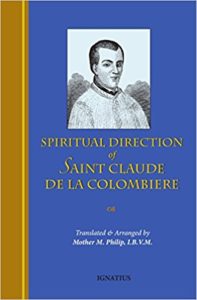
 Sunday of the Sixth Week in Ordinary Time – A Time of Lectio Divina for the Discerning Heart Podcast
 Join Dan Burke and Kris McGregor as they discuss the teachings of the great spiritual master and Doctor of the Church, St. Teresa of Avila. The focus of their conversations will primarily reside in St. Teresa’s “Interior Castle” and her wisdom in regard to the activity of the enemy and the reality of spiritual warfare.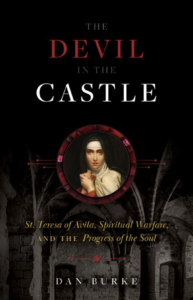

 Sunday of the Fifth Week in Ordinary Time – A Time of Lectio Divina for the Discerning Heart Podcast