

Podcast: Play in new window | Download (Duration: 25:29 — 17.5MB) | Embed
Subscribe: Apple Podcasts | Spotify | Amazon Music | Android | Pandora | iHeartRadio | JioSaavn | Podchaser | Gaana | Podcast Index | Email | TuneIn | Deezer | Anghami | RSS | More
 Episode 7 – Valentinus – Villains of the Early Church with Mike Aquilina
Mike Aquilina and Kris McGregor explore the figure of Valentinus, an early second-century teacher whose ideas became one of the most significant challenges to the young Church. Valentinus built an exclusive movement that claimed access to hidden teachings unavailable to ordinary Christians, rejected the true incarnation by treating matter as corrupt, and cultivated a social atmosphere that appealed to wealthy Romans seeking prestige and safety. His approach fit within the broader stream of Gnosticism, a recurring pattern in history that appeals to those who want to view themselves as spiritually superior or part of a select inner circle. The Fathers—especially Irenaeus and Tertullian—carefully examined and critiqued these ideas, noting their internal contradictions and their departure from the apostolic witness.
The Church’s response clarified essential truths: the goodness of creation, the real incarnation of Christ, the harmony of Scripture’s layers of meaning, and the universal call of the Gospel. Movements like Valentinus’s ultimately fragmented because they relied on private revelations without a stable authority. This episode also highlights how similar attitudes appear in every age, even within Catholic circles—whenever people treat the faith as a private club or disregard the embodied, communal, and historical character of Christianity. By recalling the errors of Valentinus, it invites us to remain rooted in the Church’s public teaching, the witness of the saints, and the shared life of the whole People of God.
Discerning Hearts Reflection Questions
- How does the appeal of Valentinus’s exclusive “inner circle” challenge me to examine whether I ever treat my faith as a status symbol rather than a gift meant for all?
- In what ways do I struggle to accept the goodness of my own body, and how does the Incarnation invite me to see it differently?
- Where in my life do I rely too heavily on my own insights instead of the apostolic teaching safeguarded by the Church?
- How might I cultivate deeper unity with the whole parish community, including those I find difficult to relate to?
- What practices help me stay grounded in the public, communal nature of the Gospel rather than seeking spiritual shortcuts or secret paths?
- How does the Church’s teaching on the resurrection of the body challenge my assumptions about what salvation truly involves?
- What can the rise and collapse of movements like Valentinus’s teach me about the need for humility and accountability in spiritual leadership?
- How does reflecting on the early Church’s struggles strengthen my gratitude for the stability and clarity offered through the magisterium today?
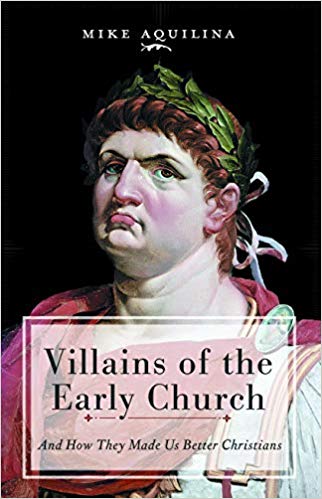
An excerpt from Villains of the Early Church
“We know almost nothing about Valentinus the man except that he was well educated. He had much more higher education than the average Christian: he had studied at Alexandria, so he had the ancient equivalent of a Harvard or Oxford degree. He had specialized in Platonic studies, meaning that he knew Plato backwards and forwards, at least as Plato was interpreted by later students who claimed to have understood him. (Like many philosophy students today, Valentinus probably learned about Plato from secondary sources more than from actually reading Plato.)
In about 130, Valentinus came to Rome and he stayed there for about twenty years. Thus, he was in Rome at the same time as Marcion. Valentinus later ended up in Cyprus.1
One thing his opponents gave Valentinus credit for was his brain. Tertullian and, much later, Jerome both considered him to have a formidable mind. But he applied that mind to creating an incredibly convoluted mythology rather than simply understanding the Scriptures. In this Valentinus was just like all the other Gnostics: incredibly convoluted mythologies were their stock in trade. The simple truth was for simple people. Like some academics today, the Gnostic teachers felt a need to prove their intellectual worth by filling their writings with jargon nobody but other Gnostics could understand.”
Aquilina, Mike. Villains of the Early Church: And How They Made Us Better Christians. Emmaus Road Publishing. Kindle Edition.
You can find the book on which this series is based here.
For more episodes in the Villians of the Early Church podcast visit here – Villains of the Early Church – Discerning Hearts Podcast
Mike Aquilina is a popular author working in the area of Church history, especially patristics, the study of the early Church Fathers.[1] He is the executive vice-president and trustee of the St. Paul Center for Biblical Theology, a Roman Catholic research center based in Steubenville, Ohio. He is a contributing editor of Angelus (magazine) and general editor of the Reclaiming Catholic History Series from Ave Maria Press. He is the author or editor of more than fifty books, including The Fathers of the Church (2006); The Mass of the Early Christians (2007); Living the Mysteries (2003); and What Catholics Believe(1999). He has hosted eleven television series on the Eternal Word Television Network and is a frequent guest commentator on Catholic radio.