
Podcast: Play in new window | Download (Duration: 29:19 — 20.4MB) | Embed
Subscribe: Apple Podcasts | Spotify | Amazon Music | Android | Pandora | iHeartRadio | JioSaavn | Podchaser | Gaana | Podcast Index | Email | TuneIn | Deezer | Anghami | RSS | More

Episode 3: Praying Always – Communion with Christ: Practical Prayer with Deacon James Keating
Deacon James Keating joins host Kris McGregor to explore Jesus Christ as the perfect model and source of Christian prayer, drawing upon the teachings of the Catechism of the Catholic Church. Jesus reveals what it means to live in constant communion with the Father, inviting us to participate in that relationship through the Holy Spirit. Deacon Keating explains how intentional moments of silence, listening, and contemplation gradually transform our lives so that prayer becomes more than an activity; it becomes a way of being. Through Christ’s example of thanksgiving and gratitude, we learn to recognize the Father as the source of every gift and to approach prayer with confidence in His providence. As our spiritual lives mature, our deepest desire shifts from seeking what God can give us to seeking God Himself, discovering that true fulfillment comes through communion with Him.
The conversation also explores the profound connection between prayer, the Eucharist, and Christ’s self-offering on the Cross. Deacon Keating describes the Mass as the source and summit of our prayer, where we are invited to unite ourselves with Jesus’ complete surrender to the Father. Even in His suffering, Christ prayed for those who persecuted Him and extended mercy to the repentant thief, revealing a love that remains directed toward others. This example teaches us to unite our own suffering with Christ’s sacrifice and to offer it in intercession for others. Reflecting on the good thief’s humble plea for mercy, Deacon Keating illustrates how authentic prayer arises when we acknowledge our spiritual poverty and surrender our self-reliance. Through the grace of the Holy Spirit, we are drawn into a deeper relationship with Christ, where prayer becomes an encounter with His mercy, a growing trust in His promises, and a foretaste of eternal communion with God.
From the Catechism of the Catholic Church paragraph 2567
“God calls man first. Man may forget his Creator or hide far from his face; he may run after idols or accuse the deity of having abandoned him; yet the living and true God tirelessly calls each person to that mysterious encounter known as prayer. In prayer, the faithful God’s initiative of love always comes first; our own first step is always a response. As God gradually reveals himself and reveals man to himself, prayer appears as a reciprocal call, a covenant drama. Through words and actions, this drama engages the heart. It unfolds throughout the whole history of salvation.”
Check out Deacon Keating’s “Discerning Hearts” page
You can find the book here.
Discerning Hearts Questions for Reflection and Study
Personal Reflection
- Do I approach prayer primarily to ask God for what I need, or do I make time simply to be with Him?
- How can I become more attentive to the presence of Jesus throughout my daily activities and responsibilities?
- What blessings in my life have I taken for granted, and how can I express greater gratitude to the Father?
- Am I willing to set aside intentional moments of silence to listen for the voice of Christ within my heart?
- When my prayers seem unanswered, do I continue to trust that God hears me and desires my ultimate good?
- How can I more consciously unite my personal prayers and sacrifices with Christ’s self-offering in the Eucharist?
- When I experience physical, emotional, or spiritual suffering, do I allow that suffering to draw me closer to Jesus and deepen my compassion for others?
- Is there someone in my life for whom I can offer my difficulties as an act of loving intercession?
- What areas of pride, self-reliance, or distraction prevent me from approaching Jesus with the humility of the repentant thief?
- If Jesus were inviting me today into a deeper communion with Himself, what would I need to surrender to receive His love more fully?
Group Reflection or Study
- What does Deacon Keating mean when he describes Jesus as prayer itself coming among us, and how does this deepen our understanding of Christ as our teacher of prayer?
- How does Jesus’ constant communion with the Father help us understand St. Paul’s instruction to pray without ceasing?
- Why is gratitude essential to Christian prayer, and how does recognizing God as the source of all good things transform our relationship with Him?
- What is the difference between approaching God primarily for His gifts and approaching Him out of a desire for communion with Him?
- How does the healing of the ten lepers illustrate the deeper purpose of Christ’s gifts and miracles?
- Why does Deacon Keating describe the Eucharist as the source from which all Christian prayer flows and to which it returns?
- What does Jesus’ prayer from the Cross reveal about the relationship between suffering, forgiveness, and intercession?
- How does the repentant thief’s encounter with Jesus demonstrate the importance of humility, spiritual poverty, and trust in divine mercy?
- What role does the Holy Spirit play in transforming our prayer from outward religious activity into an authentic encounter with God?
- How can participation in the Mass prepare us for the ultimate communion with God that awaits us in eternal life?
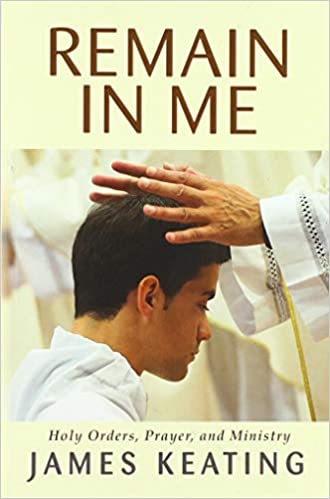 From the book description:
The book addresses their mutual dedication to remain with Christ in prayer even in the service of parishioners. Once prayer finds a place in the heart, compassion grows for those who look for God “like sheep without a shepherd.” Through interior prayerfulness, clerical unity in ministry can be better ensured Remain in Me is for priests and deacons to use as prayer, on retreat, or during the holy seasons of Lent and Advent.
Deacon James Keating, Ph.D., is a professor of Spiritual Theology and serves as a spiritual director at Kenrick Glennon Seminary in St. Louis, MO.