
Lectio Divina is the traditional Christian practice of prayerfully reading and listening to Sacred Scripture. The words mean “divine reading,” but Lectio Divina is more than reading a biblical passage for information. It is a way of becoming attentive to the Word of God, allowing Scripture to enter the heart, and responding to the Lord in prayer.
The traditional movement of Lectio Divina is often described through four movements: lectio, prayerful reading and listening; meditatio, pondering the Word in the heart; oratio, responding to God in prayer; and contemplatio, resting quietly and attentively in His presence.
There is no need to hurry through these movements. A word, phrase, or image from Scripture may draw your attention. Remain with it. Listen. Allow the Word to become prayer.
Discerning Hearts offers Daily Lectio Divina as a way to enter this ancient practice through the Gospel proclaimed each day in the Church’s liturgy.
➜ Pray with Today’s Gospel: Daily Lectio Divina
➜ Explore Benedictine Spirituality and Prayer on Discerning Hearts
Resources for Learning to Pray with Scripture
HR 21 – How to Overcome Anger – The Holy Rule of St. Benedict with Fr. Mauritius Wilde O.S.B
Podcast: Play in new window | Download (Duration: 40:46 — 28.1MB) | Embed
Subscribe: Apple Podcasts | Spotify | Amazon Music | Android | Pandora | iHeartRadio | JioSaavn | Podchaser | Gaana | Podcast Index | Email | TuneIn | Deezer | Anghami | RSS | More
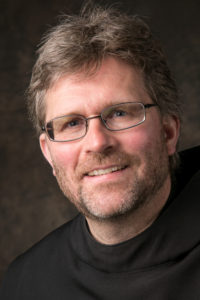
How to Overcome Anger – The Holy Rule of St. Benedict with Fr. Mauritius Wilde O.S.B
Fr. Mauritius Wilde, OSB and Kris McGregor explore St. Benedict’s practical wisdom for dealing with anger, beginning with the simple instruction from Chapter 4 of the Rule: “You are not to act in anger.” Fr. Mauritius makes an important distinction between experiencing anger and allowing anger to control our actions. Anger itself is part of the human experience and can even provide the energy necessary to recognize injustice and defend what is good. Jesus Himself displays what Fr. Mauritius calls a “sacred anger.” The real spiritual question, then, is what we do with anger. Instead of immediately reacting, we are called to become aware of it and discover what may lie beneath it, particularly hurt, fear, or sadness.
Fr. Mauritius offers four practical steps for transforming anger: become aware of it, accept it and bring it to prayer, take a deep breath, and pray for meekness and mercy. Drawing on the Psalms, the Desert Fathers, Evagrius Ponticus, and the example of St. Paul in Athens, he shows how prayer can purify even righteous anger so that our response remains rooted in love rather than bitterness or revenge. The goal is not passivity. Christians should be moved by injustice, suffering, and evil, but even when we are right, we must resist allowing anger to separate us from the person before us. Meekness enables us to act firmly when necessary while continuing to recognize the image of God in the other.
The difference between sacred anger and destructive anger.
- Become aware of your anger – identify the emotions which fuel the anger (i.e. sadness, fear, hurt, bitterness, etc.)
- Accept it and take it to prayer
- Take a deep breath
- Pray for meekness and mercy
Discerning Hearts Reflection Questions
- When anger begins to rise in me, do I recognize it before I react, or do I usually become aware of it only afterward?
- Fr. Mauritius suggests that hurt, fear, or sadness often lies beneath anger. What might be underneath the anger I experience most often?
- Is there a difference between the things that make me angry because I have been personally offended and those that stir me because something truly unjust is occurring?
- When I believe my anger is justified, do I still bring it to prayer before I respond?
- Have I ever allowed another person’s anger to draw me into anger of my own? What might it look like simply to refuse to enter that “bubble of anger”?
- Fr. Mauritius uses St. Paul in Athens as an example of remaining connected to people even when we believe they are wrong. Can I continue to recognize the image of God in someone with whom I strongly disagree?
- What would it mean for me to pray specifically for meekness and mercy when I feel angry?
- St. Benedict tells us, “You are not to act in anger.” What situation in my life right now might require me to stop, take a breath, pray, and respond rather than react?
For more episodes from this series and other podcasts, visit:
Fr. Mauritius Wilde’s Discerning Hearts page
Father Mauritius Wilde, OSB, Ph.D., did his philosophical, theological, and doctoral studies in Europe. He is the author of several books and regularly directs retreats. He serves as Prior at Sant’Anselmo in Rome.
HR 20 – Prayer During the Night- The Holy Rule of St. Benedict with Fr. Mauritius Wilde O.S.B – Discerning Hearts Podcasts
Podcast: Play in new window | Download (Duration: 30:31 — 21.2MB) | Embed
Subscribe: Apple Podcasts | Spotify | Amazon Music | Android | Pandora | iHeartRadio | JioSaavn | Podchaser | Gaana | Podcast Index | Email | TuneIn | Deezer | Anghami | RSS | More
Prayer During the Night – The Holy Rule of St. Benedict with Fr. Mauritius Wilde O.S.B
In this episode of The Holy Rule of St. Benedict: A Spiritual Path for Today’s World, Fr. Mauritius Wilde, OSB and Kris McGregor explore St. Benedict’s striking attention to prayer during the night and in the quiet hours of early morning. Beginning with Chapter 8 of the Rule, Fr. Mauritius explains why Benedict structured the monastic day around Vigils, inviting the monks to rise while the world is still dark and quiet. These hours offer a particular openness to God, when the noise and activity of the coming day have not yet taken hold. Prayer at this hour does not require perfect concentration or extraordinary effort. Fr. Mauritius offers a wonderfully simple counsel: just be there. Bring yourself before God, pray the Psalms, and allow Him to speak and work within you.
The conversation also offers beautiful guidance for anyone who awakens during the night with worries, fears, or an inability to return to sleep. Rather than struggling for control or immediately turning to work, television, or a device, Fr. Mauritius suggests receiving the unexpected wakefulness as an opportunity for prayer and surrender. Night exposes our vulnerability, but precisely there we can entrust ourselves more completely to God and encounter the light of Christ. Evening prayer prepares the heart to enter sleep in God’s presence, while morning prayer allows praise to become our first response to the new day. In this Benedictine rhythm, the night itself becomes a place of encounter, surrender, consolation, and unceasing prayer.
From the Holy Rule of St. Benedict Chapter 8:
From the Holy Rule of St. Benedict:
CHAPTER VIII
Of the Divine Office during the Night
Making due allowance for circumstances, the brethren will rise during the winter season, that is, from the calends of November till Easter, at the eighth hour of the night; so that, having rested till a little after midnight, they may rise refreshed. The time, however, which remains over after the night office (Matins) will be employed in study by those of the brethren who still have some parts of the psalms and the lessons to learn.
Discerning Hearts Reflection Questions
- What usually occupies the final moments of my day? How might evening prayer change the way I enter into sleep?
- When I wake during the night with worries or fears, what is my first response? Could I receive some of those moments as an invitation to turn toward God?
- Fr. Mauritius says that during early morning prayer we do not have to accomplish anything extraordinary: “Just be there.” What would it mean for me simply to place myself in God’s presence?
- What might I need to surrender to God before going to sleep so that anxiety does not accompany me through the night?
- How could I protect the first moments of my morning from noise, news, screens, and other distractions so that God receives my first attention?
- The monks begin their morning prayer with, “Lord, open my lips, and my mouth will proclaim your praise.” How might this prayer shape my words and encounters throughout the day?
- Fr. Mauritius describes sleep as an exercise in relinquishing control and allowing ourselves to be held by God. Where is the Lord inviting me to trust Him more deeply?
- How might establishing a simple rhythm of evening and morning prayer help me grow toward the unceasing prayer St. Benedict desires?
For more episodes from this series and other podcasts, visit:
Fr. Mauritius Wilde’s Discerning Hearts page
Father Mauritius Wilde, OSB, Ph.D., did his philosophical, theological, and doctoral studies in Europe. He is the author of several books and regularly directs retreats. He serves as Prior at Sant’Anselmo in Rome.
BTP#30 St. Benedict, Listening, and Discernment – Beginning to Pray with Dr. Anthony Lilles – Discerning Hearts
Podcast: Play in new window | Download (Duration: 29:35 — 20.3MB) | Embed
Subscribe: Apple Podcasts | Spotify | Amazon Music | Android | Pandora | iHeartRadio | JioSaavn | Podchaser | Gaana | Podcast Index | Email | TuneIn | Deezer | Anghami | RSS | More
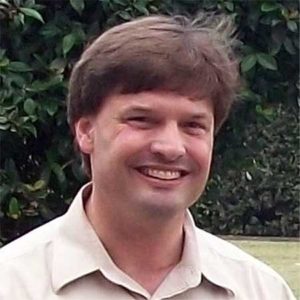
BTP30 St. Benedict, Listening and Discernment – The Mystery of Faith in the Wisdom of the Saints. In this episode, Dr. Lilles offers a general introduction to this series, the mystical key to discernment, and teaching of St. Benedict.
Dr. Lilles offers 4 key points we should keep in mind as we move forward in this series
1. The Search for God
2. Listening to God – Lectio Divina
3. Conversion to God – Conversatio Morum
4. Living with oneself and letting God fashion one into His image
All four points can be found in the “Holy Rule of St. Benedict” paragraph #58:
CHAPTER LVIII
Of the Manner of Admitting BrethrenLet easy admission not be given to one who newly cometh to change his life; but, as the Apostle saith, “Try the spirits, whether they be of God” (1 Jn 4:1). If, therefore, the newcomer keepeth on knocking, and after four or five days it is seen that he patiently beareth the harsh treatment offered him and the difficulty of admission, and that he persevereth in his request, let admission be granted him, and let him live for a few days in the apartment of the guests.
But afterward let him live in the apartment of novices, and there let him meditate, eat, and sleep. Let a senior also be appointed for him, who is qualified to win souls, who will observe him with great care and see whether he really seeketh God, whether he is eager for the Work of God, obedience and humiliations. Let him be shown all the hard and rugged things through which we pass on to God.
If he promiseth to remain steadfast, let this Rule be read to him in order after the lapse of two months, and let it be said to him: Behold the law under which thou desirest to combat. If thou canst keep it, enter; if, however, thou canst not, depart freely. If he still persevereth, then let him be taken back to the aforesaid apartment of the novices, and let him be tried again in all patience. And after the lapse of six months let the Rule be read over to him, that he may know for what purpose he entereth. And if he still remaineth firm, let the same Rule be read to him again after four months. And if, after having weighed the matter with himself he promiseth to keep everything, and to do everything that is commanded him, then let him be received into the community, knowing that he is now placed under the law of the Rule, and that from that day forward it is no longer permitted to him to wrest his neck from under the yoke of the Rule, which after so long a deliberation he was at liberty either to refuse or to accept.
Let him who is received promise in the oratory, in the presence of all, before God and His saints, stability, the conversion of morals, and obedience, in order that, if he should ever do otherwise, he may know that he will be condemned by God “Whom he mocketh.” Let him make a written statement of his promise in the name of the saints whose relics are there, and of the Abbot there present. Let him write this document with his own hand; or at least, if he doth not know how to write, let another write it at his request, and let the novice make his mark, and with his own hand place it on the altar. When he hath placed it there, let the novice next begin the verse: “Uphold me, O Lord, according to Thy word and I shall live; and let me not be confounded in my expectations” (Ps 118[119]:116). Then let all the brotherhood repeat this verse three times, adding the Gloria Patri.
The let that novice brother cast himself down at the feet of all, that they may pray for him; and from that day let him be counted in the brotherhood. If he hath any property, let him first either dispose of it to the poor or bestow it on the monastery by a formal donation, reserving nothing for himself as indeed he should know that from that day onward he will no longer have power even over his own body.
Let him, therefore, be divested at once in the oratory of the garments with which he is clothed, and be vested in the garb of the monastery. But let the clothes of which he was divested by laid by in the wardrobe to be preserved, that, if on the devil’s suasion he should ever consent to leave the monastery (which God forbid) he be then stripped of his monastic habit and cast out. But let him not receive the document of his profession which the Abbot took from the altar, but let it be preserved in the monastery.
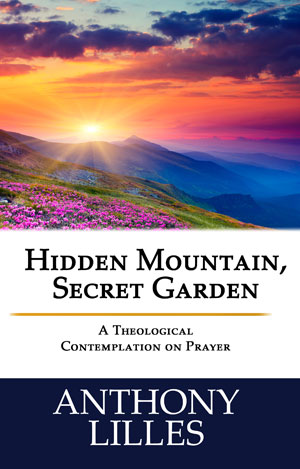 Dr.Anthony Lilles is a Catholic husband and father of three teaching Spiritual Theology at St. John Vianney Theological Seminary. He teaches spiritual theology and spiritual direction to transitional deacons, and the spiritual classics to the men who enter the Spirituality Year, a year of prayer in preparation for seminary formation. He is the author of the “Beginning to Pray” Catholic blog spot.
For other episodes in the series visit the Discerning Hearts page for Dr. Anthony Lilles
Here is the bibliography that Dr. Lilles spoke of in this episode:
The Mystery of Faith in the Wisdom of the Saints
Saints, other figures, dates and bibliographic information
St. Benedict of Nursia – b. 480 – d. 547.
St. Benedict. The Rule. Edited by Timothy Fry, O.S.B. New York: Vintage Books, Random House, 1981, 1998.
➜ Explore Benedictine Spirituality and Prayer on Discerning Hearts
IP#352 Dr. Peter Kreeft – Probes on Inside the Pages with Kris McGregor Podcast
Podcast: Play in new window | Download (Duration: 26:24 — 18.2MB) | Embed
Subscribe: Apple Podcasts | Spotify | Amazon Music | Android | Pandora | iHeartRadio | JioSaavn | Podchaser | Gaana | Podcast Index | Email | TuneIn | Deezer | Anghami | RSS | More
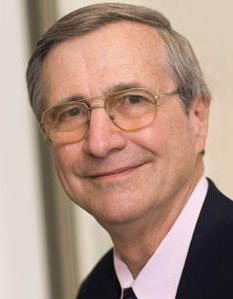
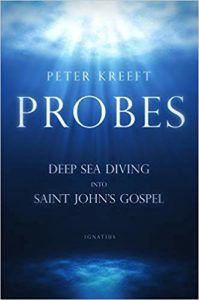
“Probes: Deep Sea Diving into St. John’s Gospel” is a beautiful union of Scripture Study and the prayer experience of Lectio Divina. I’ve never seen anything quite like it (and I hope I see more). What the reader will find is that diving deeper is actually climbing higher. Under Dr. Kreeft’s guidance, we learn to ask penetrating questions of Sacred Scripture, but more importantly, we learn to listen to the Word for the answers. Designed for community study or individual reflection, this is the “John” book I have been waiting for! Thank you once again Dr. Kreeft!
You can find the book here
From the book description:
This is no ordinary book. It is a set of probing questions (1,450 in fact) designed to help individuals or groups, especially groups, to dive deeply into Saint John’s Gospel. No answers are provided, but the questions are phrased in such a way as to set a person in a reliable direction for finding the answers.
The questions correspond to the verses of the Gospel and require active and personal interaction. Some of the questions are easy, some difficult, and they are marked accordingly. Some questions include background information or hints that help the reader along. Some were written with a fair bit of humor. Any person or group using these questions to explore John will find themselves entertained as well as informed and inspired.
IP#484 – Deacon James Keating Ph.D. – Abiding in Christ on Inside the Pages with Kris McGregor Podcast
Podcast: Play in new window | Download (Duration: 41:56 — 28.9MB) | Embed
Subscribe: Apple Podcasts | Spotify | Amazon Music | Android | Pandora | iHeartRadio | JioSaavn | Podchaser | Gaana | Podcast Index | Email | TuneIn | Deezer | Anghami | RSS | More
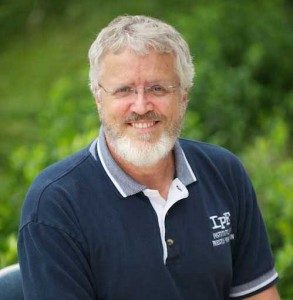
In this compelling conversation with Deacon James Keating, a spiritual master of the highest order, we discuss those things that block us from having a closer relationship with God. We also discuss the importance of making time for Lectio Divina, living in the liturgy of the Church, and the danger of letting prayer become too complex.
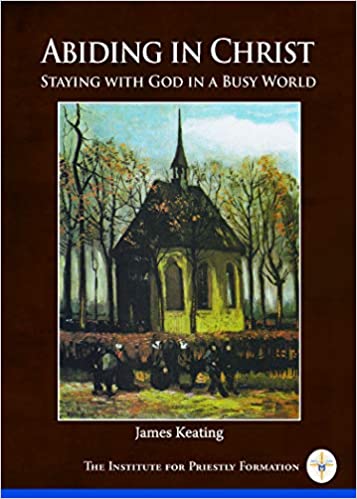
Abiding in Christ: Staying with God in a Busy World is a wonderful how-to-pray resource. This book helps readers to find a quiet space wherein they can be present to God and offers suggestions of how they can be more open to God’s movement within them. We highly recommend this book to those souls seeking a deeper relationship with God.
 You can find the book here
Here are excerpts from our conversation in the podcast –
Sin, to some extent, possesses us, usually at the level of pleasure. Even if you think about the sin of anger, it always seems like it’s mayhem, but it’s actually pleasurable. People get a rush out of being angry. They get a rush out of being greedy. There’s a pleasure in sloth, in daydreaming, in fantasizing, in not doing the duty or the work we’re supposed to do right in front of us. There’s a pleasure in sloth.
And so that pleasure is the glue, the adhesive that keeps us in love with our sins. And that’s what God is alwaying fighting. He’s trying to displace that false love that we have set up by the way of pleasure. God knows that pleasure is not the deepest reality of existence. And so he’s not going to play the game back and like trump the pleasure of sin. He is going to attract us away from the pleasure of sin, by the beauty of truth.
As Joseph Ratizinger used to say, “The face of God, is the beauty of God’s face.” What’s that mean? That means that the truth, the radiance of truth will eventually win us over even against the strong undertow of sin’s pleasure. If we give him a chance, spend time with him, open our hearts to be affected by him, then over time, this beauty of his own face, the truth of who God is will move us away from the immediacy, the gratification of the pleasure that’s hiding within all of our sins. And that’s what salvation is. Salvation is finally surrendering to truth and its beauty over and against the fleeting pleasure of self-involvement
also
The liturgy is your participation in being loved and loving back. Catechesisis not learning in a classroom style. It’s learning how to pray. If we don’t learn how to pray, we won’t even be interested in the catechism. Why would you be interested in the catechism if you don’t know the person whose voluminous beauty fills the catechism? Why would you want to open that book?
The Catechism at its heart is learning how to be with Him, to receive Him. And then your intellect is a flame to want to know Him. We do it backwards. We’ve always done it backwards. I don’t know for how long, but since my birth, we’ve done it backwards. Reducing the mystery to academics. And that’s inherently boring because to study anybody you don’t know, to study anyone that you have no motivation to learn about, is boredom. So we have to let them be burned by the fire first. This is why to some extent, parishes have to be remodeled. Maybe God is doing this by making our parishes so much smaller.
People are leaving. They’re not saying this. They’re leaving because they’re bored. They’re leaving because they haven’t encountered. They’re leaving because they don’t know God. And they’re looking for God, but maybe we have to make our parishes more like retreat centers than some type of bureaucratic paperwork center where you go through and get certified to receive this sacrament or that sacrament. It has to be more of a retreat encounter so that people will want to know God because they’ve met to God.
For more Deacon James Keating on Discerning Hearts visit his podcasts here
IP#482 Dr. Peter Kreeft – Wisdom from the Psalms on Inside the Pages with Kris McGregor Podcast
Podcast: Play in new window | Download (Duration: 36:47 — 25.4MB) | Embed
Subscribe: Apple Podcasts | Spotify | Amazon Music | Android | Pandora | iHeartRadio | JioSaavn | Podchaser | Gaana | Podcast Index | Email | TuneIn | Deezer | Anghami | RSS | More
Wisdom from the Psalms has become one of my all-time favorite Dr. Peter Kreeft books. Not only does this book inspire me to think and learn, but best of all it helped me to grow even more deeply in love with the Psalms and prayer. This particular podcast is a favorite as well. The Psalms only get better (is that possible?) when experienced with such an incredible guide. Give your prayer life a big boost and pick up a copy of this wonderful book.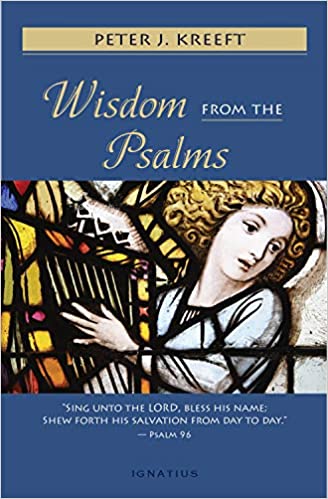 You can find the book here
From the book description:
The Psalms are the most popular, most universally loved and used book in the Bible, which in turn is the most popular book in the world. They are hymns, songs, poems and prayers, both formal (liturgical and communal) and informal (spontaneous, personal, and individual); and this gives them many layers of meaning rather than one, unlike theologies and creeds.
They Psalms are literally inexhaustible, so a new book of reflections on them is always welcome. Especially a book by the beloved, widely read, best-selling author and philosopher, Peter Kreeft.
In this work Kreeft shares his personal explorations into the riches of the Psalms, his profound expeditions into this deep ocean of the divinely inspired spiritual water. He focuses on the dozen or so Psalms that are most people’s favorites, including Kreeft.
Kreeft says that the Pslams are powerful prayers, and a spiritual weapon that God himself has given us for our great task of spiritual warfare, which is human life on earth.
What prayers did Jesus and his disciples pray? The Psalms! As all Jews have always done ever since they had them. The Psalms are God’s answer to our plea, ‘Teach us to pray.’ Christ prayed them not only in synagogue but throughout His life, and at his death. He prayed Psalm 22, ‘My God, my God, why hast Thou forsaken me?’ even as He was dying on the Cross.
– Peter Kreeft, from the Introduction
IP#363 Fr. John Bartunek – The Better Part: The Gospels pt. 1 on Inside the Pages with Kris McGregor Podcast
Podcast: Play in new window | Download (Duration: 28:30 — 19.6MB) | Embed
Subscribe: Apple Podcasts | Spotify | Amazon Music | Android | Pandora | iHeartRadio | JioSaavn | Podchaser | Gaana | Podcast Index | Email | TuneIn | Deezer | Anghami | RSS | More
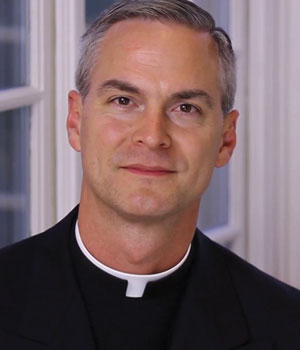 With Fr. John Bartunek, we begin part 1 of our discussion on “The Better Part: The Gospels.” During our conversation, we discuss the importance of prayer and the scriptures, the nature of spiritual direction, and how we can develop our friendship with Christ. It’s always a joy to talk with Fr. Bartunek. We couldn’t recommend this 4-volume set more highly.
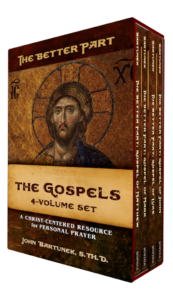 You can find the set here
From the book description
Every saint and renowned spiritual director through the ages has said the same thing: if we desire to become saints, we must spend time daily in meditation. With this set, Fr. John Bartunek has created an extensive, Christ-centered resource to serve as your daily meditation companion. The Better Part offers a practical explanation of Christian meditation, as well as material to draw from during your meditations, including a Bible study on the Gospels, a survey of saints writings, and a handy guide to prayer.
As you learn to read, meditate upon, absorb, and apply the Gospels to your life, you’ll also find ways to personalize your times of prayer, allowing you to follow the Holy Spirit’s lead along the path of holiness. Open these pages to discover the methods of meditation that best suit you, develop your friendship with Christ, and experience the true Christian joy of a deep, fruitful life of prayer.
IP#152 Stephen Binz – Learning to Pray with Scripture on Inside the Pages
Podcast: Play in new window | Download (Duration: 28:15 — 45.3MB) | Embed
Subscribe: Apple Podcasts | Spotify | Amazon Music | Android | Pandora | iHeartRadio | JioSaavn | Podchaser | Gaana | Podcast Index | Email | TuneIn | Deezer | Anghami | RSS | More
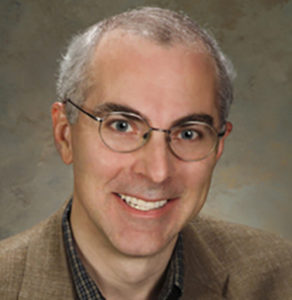
Stephen J. Binz is a Catholic biblical scholar, psychotherapist, popular speaker, and award-winning author of more than thirty books on the Bible and biblical spirituality. “Learning to Pray with Scripture” is another volume in the excellent “Lectio Divina” series brought to us by Our Sunday Visitor. In it, Stephen uses the actual prayers of Sacred Scripture to help us enter a deeper relationship with God through our own prayer. This series is outstanding and an absolute MUST for those seeking a great guide to this ancient prayer form!
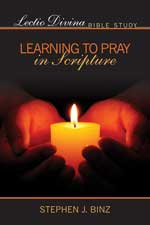
You can find this book here
This study shows the way that various characters in the Bible prayed and what they can teach you about prayer.
It also delves into various types of prayer and what you can learn from them.
Every chapter leads you forward through a sequence of:
- Listening – Reading Scripture with expectancy, trusting that God will speak His Word to us through it
- Understanding – Seeking to comprehend the meaning of the text, encountering God there and being changed by that encounter
- Reflecting – Linking the truth of the Scriptures to the experience of faith in the world in which we live
- Praying – A dialogue with God: we listen to God, then we respond in prayer
- Acting – After prayerfully listening to God through a passage of Scripture, we should be inspired to make a difference in the way we live
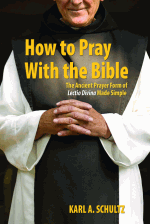
IP#83 Karl Schultz – How to Pray with the Bible on Inside the Pages
Sometimes when folks think of the practice of Lectio Divina, the spiritual prayer of pondering God’s Word, they  think of a quiet meditation. But more than that, Karl Schultz, the author of “How to Pray with the Bible -The Ancient Prayer Form of Lectio Divina Made Simple”, shows us that it might be quiet, it is also vibrant, interactive and a deeply fulfilling relationship with God in prayer. Karl is a master of this type of prayer and has much to share. I love it! As a Benedictine oblate, it is at the heart of our spiritual practice. Not to be missed, take a listen….
Podcast: Play in new window | Download (Duration: 28:00 — 25.6MB) | Embed
Subscribe: Apple Podcasts | Spotify | Amazon Music | Android | Pandora | iHeartRadio | JioSaavn | Podchaser | Gaana | Podcast Index | Email | TuneIn | Deezer | Anghami | RSS | More