Msgr. Esseff teaches the importance of fasting, almsgiving and the Liturgy of the Hours during the season of Lent. He shares his experience of fasting in a desert found in Peru. From this he learned the importance of FASTING and PRAYER. Msgr. Esseff challenges us to discern what the Father in Heaven is asking us to do this Lent through fasting, so we can purely and perfectly follow His Holy Will. And he describes ALMSGIVING, and story from an experience he had with Mother Teresa’s Missionaries of Charity Sisters.
The Church prepares a spiritual retreat for all of us during Lent. The Holy Spirit is transforming you in a radical way so that you become more like Jesus Christ…the day by day exercise of Morning Prayer, the Eucharist and Evening Prayer, Fasting and Almsgiving, and the other moments of contemplative prayer aids in the transformation…our ego decreases and Jesus increases in our minds and in our hearts.
Deacon James Keating Ph.D. – Abiding in Christ on Inside the Pages with Kris McGregor
In this compelling conversation with Deacon James Keating, a spiritual master of the highest order, we discuss those things that block us from having a closer relationship with God. We also discuss the importance of making time for Lectio Divina, living in the liturgy of the Church, and the danger of letting prayer become too complex.
Abiding in Christ: Staying with God in a Busy World is a wonderful how-to-pray resource. This book helps readers to find a quiet space wherein they can be present to God and offers suggestions of how they can be more open to God’s movement within them. We highly recommend this book to those souls seeking a deeper relationship with God.
Here are excerpts from our conversation in the podcast –
“Sin, to some extent, possesses us, usually at the level of pleasure. Even if you think about the sin of anger, it always seems like it’s mayhem, but it’s actually pleasurable. People get a rush out of being angry. They get a rush out of being greedy. There’s a pleasure in sloth, in daydreaming, in fantasizing, in not doing the duty or the work we’re supposed to do right in front of us. There’s a pleasure in sloth.
And so that pleasure is the glue, the adhesive that keeps us in love with our sins. And that’s what God is alwaying fighting. He’s trying to displace that false love that we have set up by the way of pleasure. God knows that pleasure is not the deepest reality of existence. And so he’s not going to play the game back and like trump the pleasure of sin. He is going to attract us away from the pleasure of sin, by the beauty of truth.
As Joseph Ratizinger used to say, “The face of God, is the beauty of God’s face.” What’s that mean? That means that the truth, the radiance of truth will eventually win us over even against the strong undertow of sin’s pleasure. If we give him a chance, spend time with him, open our hearts to be affected by him, then over time, this beauty of his own face, the truth of who God is will move us away from the immediacy, the gratification of the pleasure that’s hiding within all of our sins. And that’s what salvation is. Salvation is finally surrendering to truth and its beauty over and against the fleeting pleasure of self-involvement.”
also
“The liturgy is your participation in being loved and loving back. Catechesisis not learning in a classroom style. It’s learning how to pray. If we don’t learn how to pray, we won’t even be interested in the catechism. Why would you be interested in the catechism if you don’t know the person whose voluminous beauty fills the catechism? Why would you want to open that book?
The Catechism at its heart is learning how to be with Him, to receive Him. And then your intellect is a flame to want to know Him. We do it backwards. We’ve always done it backwards. I don’t know for how long, but since my birth, we’ve done it backwards. Reducing the mystery to academics. And that’s inherently boring because to study anybody you don’t know, to study anyone that you have no motivation to learn about, is boredom. So we have to let them be burned by the fire first. This is why to some extent, parishes have to be remodeled. Maybe God is doing this by making our parishes so much smaller.
People are leaving. They’re not saying this. They’re leaving because they’re bored. They’re leaving because they haven’t encountered. They’re leaving because they don’t know God. And they’re looking for God, but maybe we have to make our parishes more like retreat centers than some type of bureaucratic paperwork center where you go through and get certified to receive this sacrament or that sacrament. It has to be more of a retreat encounter so that people will want to know God because they’ve met to God.”
By far, this book is the BEST on the subject of the Sacred Heart of Jesus that I have seen in a very long time. So very practical and deep in its spiritual appreciation of this beautifully essential devotion for our lives, Fr. James Kubicki helps all to rediscover the devotion to the Sacred Heart. He presents the history of this timely devotion, with help of the apostles, Church Fathers, the Saints, and contemporary Catholics, in an engaging and easily digestible way. And the prayers…the incredibly deep and radiant prayers…Fr. Kubicki breaks them open a new for us all to appreciate, encouraging us not to “say the prayers”, but to “pray the prayers”. Wonderful, simply wonderful! I cannot recommend this work more highly. Pick up more than one copy and become a missionary of the Sacred Heart of Jesus by passing copies on to others
“At first communion, I was taught to say first thing every morning, Sacred Heart of Jesus, I place all my trust in Thee!’ Reading Father Kubicki’s splendid book has only made that prayer all the more sincere and meaningful.” —Most Reverend Timothy M. Dolan, Archbishop of New York
“A fresh and attractive reconsideration of this centuries-old devotion in the Catholic Church. Blessed Basile Moreau (1873), the founder of the Congregation of Holy Cross, who entrusted his priests to the Sacred Heart of Jesus, wrote: ‘The primary purpose of the devotion to the Sacred Heart is to return love for love.’ Fr. Kubicki develops this theme in a way that speaks well to today’s generation of believers.” —Rev. Peter D. Rocca, C.S.C., Rector, Basilica of the Sacred Heart, University of Notre Dame
“I invite everyone to renew his devotion to the Sacred Heart of Christ in the month of June, making use of the traditional prayer of the offering of the day and keeping in mind the intentions that I have proposed to the whole Church.” —Pope Benedict XVI, Angelus Address, June 1, 2008
Msgr. Esseff teaches the importance of fasting, almsgiving and the Liturgy of the Hours during the season of Lent. He shares his experience of fasting in a desert found in Peru. From this he learned the importance of FASTING and PRAYER. Msgr. Esseff challenges us to discern what the Father in Heaven is asking us to do this Lent through fasting, so we can purely and perfectly follow His Holy Will. And he describes ALMSGIVING, and story from an experience he had with Mother Teresa’s Missionaries of Charity Sisters.
The Church prepares a spiritual retreat for all of us during Lent. The Holy Spirit is transforming you in a radical way so that you become more like Jesus Christ…the day by day exercise of Morning Prayer, the Eucharist and Evening Prayer, Fasting and Almsgiving, and the other moments of contemplative prayer aids in the transformation…our ego decreases and Jesus increases in our minds and in our hearts.
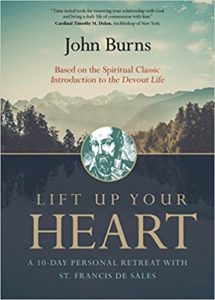
“Lift Up Your Heart: A 10-Day Personal Retreat with St. Francis de Sales” is outstanding. A wonderful “introduction to the devout life”… literally! Fr. John Burns breaks open up the teachings of the great spiritual director and Doctor of the Church St. Francis de Sales in a wonderfully fresh new way. Very practical and perfect for meditation during prayer times during the day, this is a mini-retreat we can all benefit from.
This practical book goes right to the heart of helping you kick the habit of floating along on your spiritual journey to start actively pursuing holiness and devotion to God. During the course of the retreat, you ll learn the basics of forming a daily prayer routine, including how to offer yourself to God, meditate on his love, and maintain peace in the face of suffering and clarity in the midst of temptation.
The meditations will help you:
Adopt gratitude as a daily prayer practice.
Examine and reorder your priorities and relationships to better reflect your love for God.
Discern between good and evil in your life.
Desire to love and serve as Jesus did.
In a very real sense, Burns helps you take St. Francis de Sales as your spiritual director for ten days. As you do so, you’ll feel God’s fatherly love and restart your faith life, equipped with the tools to connect with God and live for heaven now.
SJC21 – Parting Advice: Loss of Self for the Greater Love – St. John of the Cross: Master of Contemplation with Fr. Donald Haggerty – Discerning Hearts Podcast
In this series Fr. Donald Haggerty and Kris McGregor discuss the depths of prayer as explored by St. John of the Cross, the Mystical Doctor of the Church.
An excerpt from St. John of the Cross: Master of Contemplation
The last counsel regarding solitude is not directed simply to physical solitude in a monastery. The desire of Saint John of the Cross is to see the soul detached and empty, no longer dependent for security or any other interest upon the outside world. “You should deem everything in the world as finished. . . . Pay no heed to the things out in the world, for God has already withdrawn and released you from them. . . . It is very fitting for you to desire to see no one and that no one see you” (CR 7, 8).
Naturally, duties may require dealings with the world, but the religious man should remain focused on a task, not seeking to entertain himself by contact with the outside world. An inner solitude must be cultivated that remains separated from indulgence in unnecessary interests of curiosity. Saint John of the Cross urges the Carmelite Brother to take care with his thoughts so that a solitary fixation on God may be uninterrupted as much as possible. “This is very necessary for inner solitude, which demands that the soul dismiss any thought that is not directed to God” (CR 9). This last counsel is too much for most of us surely in our circumstances of distraction and busy occupations. But let us not be too dismissive. A forgetfulness of worldly concerns has the reward of bringing a soul mysteriously into the proximity with God in the midst of common occupations. We can assume that Saint John of the Cross was speaking from his own experience, as evidently he did on every page of his works.
Haggerty, Donald. Saint John of the Cross: Master of Contemplation (pp. 357-358). Ignatius Press. Kindle Edition.
SJC20 – Suffering for Love of a Crucified Beloved – St. John of the Cross: Master of Contemplation with Fr. Donald Haggerty – Discerning Hearts Podcast
In this series Fr. Donald Haggerty and Kris McGregor discuss the depths of prayer as explored by St. John of the Cross, the Mystical Doctor of the Church.
An excerpt from St. John of the Cross: Master of Contemplation
Certainly an atmosphere of great challenge pervades the writings of Saint John of the Cross. It is possible that the recurring accent on purification, interior trials, dissatisfaction in prayer, or the wounds of love in certain sections of Saint John of the Cross’ writings has a jarring or intimidating effect. His attention to painful experiences may seem to propose a spirituality of endless burdens and impossible endurance. From our perspective, this focus may be too excessive. It is not that we lack struggles and tribulations. Who does not experience them?
Yet our own thought may be that matters of trial and difficulty should be kept to a minimum and brought to a conclusion as quickly as possible. For many people, even of strong religious conviction, the common experiences of fatigue and pain compete with the pursuit of pleasures and comforts. We often find a way to compensate ourselves with worldly enjoyment if for a time we have faced trial and difficulty. Perhaps we do not ponder the Gospel deeply enough. Suffering for the sake of a profound love of God can be a neglected notion in our understanding of love, though clearly not for Saint John of the Cross: “Let Christ crucified be enough for you, and with him suffer and take your rest, and hence annihilate yourself in all inward and outward things” (SLL 92). That kind of advice is not commonly heard at any time in the Church.
Haggerty, Donald. Saint John of the Cross: Master of Contemplation (p. 317). Ignatius Press. Kindle Edition.
SJC19 – Wounds of Love – St. John of the Cross: Master of Contemplation with Fr. Donald Haggerty – Discerning Hearts Podcast
In this series Fr. Donald Haggerty and Kris McGregor discuss the depths of prayer as explored by St. John of the Cross, the Mystical Doctor of the Church.
An excerpt from St. John of the Cross: Master of Contemplation
The concealment of God’s presence, mysteriously near to our soul, yet known only by love, is at the heart of contemplation. The hidden presence of God is a truth of inescapable provocation, never fully lifted or overcome in a lifetime, showing many variations in the experience of a soul. Sometimes the hidden presence of God is stronger in the silence of prayer; other times it is met outside prayer in the sudden opportunity for sacrifice or in the disguised face of Jesus hiding in a poor person. God as elusive, hiding behind shadows, speaking in quiet whispers, disappearing from sight even in the encounter with him, is all a realization of greater faith. His presence has no predictable quality and offers no promise of an easy recognition. Shadows and darkness can become for lengthy periods the ordinary ambiance of prayer. When the darkness stretches over time and is greater, the thought of God’s withdrawal can trouble souls in their silent prayer, despite how close they may be to God.
The contemplative paradox of darkness as the setting for a very personal contact with God implies a need at times for reassurance. This comes as we deepen a calm certitude of faith in prayer and continue to long for our Lord in love and yield to him in surrender. All the while, over years of committed daily prayer, God works to bring a soul to a greater surrender to his mysterious personal love.
Haggerty, Donald. Saint John of the Cross: Master of Contemplation (pp. 290). Ignatius Press. Kindle Edition.
SJC18 – Perseverance in Prayer – St. John of the Cross: Master of Contemplation with Fr. Donald Haggerty – Discerning Hearts Podcast
In this series Fr. Donald Haggerty and Kris McGregor discuss the depths of prayer as explored by St. John of the Cross, the Mystical Doctor of the Church.
An excerpt from St. John of the Cross: Master of Contemplation
What, then, of the feelings of love that may be experienced in prayer? Are they to be denied or mortified? Ignored or renounced? Saint John of the Cross writes that they should be treated simply as secondary factors in prayer, incidental in importance. The awareness of an inflamed undercurrent of love in the will is far more significant, because it is the deeper truth. Yet it may not be encountered in an experiential manner for its deeper truth. Nonetheless, in a receptive response to a longing for God deep within the soul, this reality of love is fostered. The mistaken approach, on the other hand, is to allow a search for feelings in prayer to dominate the exercise of prayer.
For many people, feelings can become a coveted item in prayer as well as a source of continual frustration and instability—a possessive need for a satisfaction that is somehow felt and then becomes the measure of prayer, a habit hard to relinquish. Feelings of love, delightful as they may be, ought to be only a means to recognizing the more inaccessible reality of love operating at hidden layers of depth in the will and in the soul. The greater truth takes place in the unseen “cavern” of the will as it undergoes a profound “soul desire” for God. There is in every contemplative life a need, at least for a time, to release the soul from the pursuit of feelings in order to embrace this deeper recognition. Love in the will, rather than any feeling, is the much deeper truth in prayer and in contemplation.
Haggerty, Donald. Saint John of the Cross: Master of Contemplation (pp. 275-276). Ignatius Press. Kindle Edition.
SJC17 – The Will in Prayer Inflamed by Pure Love – St. John of the Cross: Master of Contemplation with Fr. Donald Haggerty – Discerning Hearts Podcast
In this series Fr. Donald Haggerty and Kris McGregor discuss the depths of prayer as explored by St. John of the Cross, the Mystical Doctor of the Church.
An excerpt from St. John of the Cross: Master of Contemplation
It can be useful initially to recall the operation of inclination in the will, the first operation of the will, as described in chapter 5. The will by its natural inclination, in or out of prayer, seeks the satisfaction of taking possession of what it desires. This natural inclination plays a crucial role in prayer. The possibility in prayer is that on certain days the delight of consolation can be received in the course of prayer. This satisfaction, which may be graced, nonetheless can detour the soul from a pure pursuit of God if it becomes the primary desire sought in prayer. The desire for a spiritual taste or feeling, as Saint John of the Cross repeats often in his writings, may replace the far greater need to turn our desire fully and exclusively toward God himself in a great surrender to him. In a letter to a Carmelite nun in Córdoba written at almost this same time in July of that same year, he writes: “To possess God in all, you should possess nothing in all. For how can the heart that belongs to one belong completely to the other?” (L17). The pure desire for God himself has to be a consuming need for a soul that would love God with intensity. Secondary desires for experiences of satisfaction in prayer must be understood as an inferior pursuit.
This teaching entails further insights and challenges. Nothing that can be enjoyed as a satisfaction in prayer should be interpreted as taking hold of God, just as no knowledge of God received in prayer is equivalent to comprehending the actual truth of God. No taste of the presence of God in prayer removes the inaccessibility of God in his divine nature to the human soul’s immediate experience. To think otherwise is to be deceived. It is necessary, then, not to halt at any experience of satisfaction in prayer as though a possession of God had been enjoyed in this delight. On the contrary, the soul must accept that the deeper truth of prayer extends always beyond any experience in prayer. The inclination of the will in prayer should remain ever desirous for God himself without arriving, as it were, at a destination in some satisfaction. In truth, a pure desire for God never arrives at a final satiation in this life, but rather is inflamed increasingly over time with an intensifying desire for God. If we enjoy some delight in prayer on any day, this experience does not convey the deeper truth of prayer, which is often concealed within unseen layers of the soul.
Haggerty, Donald. Saint John of the Cross: Master of Contemplation (pp. 270-271). Ignatius Press. Kindle Edition.


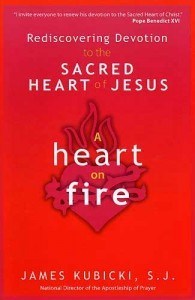
 “A fresh and attractive reconsideration of this centuries-old devotion in the Catholic Church. Blessed Basile Moreau (1873), the founder of the Congregation of Holy Cross, who entrusted his priests to the Sacred Heart of Jesus, wrote: ‘The primary purpose of the devotion to the Sacred Heart is to return love for love.’ Fr. Kubicki develops this theme in a way that speaks well to today’s generation of believers.” —Rev. Peter D. Rocca, C.S.C., Rector, Basilica of the Sacred Heart, University of Notre Dame